Vertical Plane in Engineering Drawing
An engineering cartoon is a subcategory of technical drawings. The purpose is to convey all the data necessary for manufacturing a product or a part.
Engineering science drawings utilise standardised linguistic communication and symbols. This makes agreement the drawings simple with trivial to no personal interpretation possibilities.
And then let'southward look at the different line and view types y'all volition come across in the engineering subject area.
The Purpose of Engineering Drawings
Every bit already said, such a technical drawing has all the information for manufacturing a part or welding and building an assembly. The info includes dimensions, role names and numbers, etc. And so one time a manufacturing engineer gets the drawing, he tin start the production process without a second idea.
Beginning, nosotros accept to pause for a second and address our own customers here to avoid defoliation. The drawings you submit for instant pricing and manufacturing in our system do not need any of this. The aforementioned applies to 3D models. CAD files and drawings made co-ordinate to our design tips include all the necessary information for making your product. The only time we ask for a cartoon is if you desire to specify tolerances.
Still, knowing all the rules and basics of formatting is an absolute must in the industry, every bit traditional manufacturing companies still need detailed drawings.
How to Make Drawings?
A few decades ago, you would have had to sit downward at a cartoon lath covered with papers of different size, rulers, callipers, etc. Today, all these instruments are still good for transmission drafting simply no contemporary manufacturer really wants such drawings.
Why? Because most of the machinery uses CNC systems that can read the data straight from the files and produce a cutting program accordingly. Drawings done past hand would just add together a lot of transmission work for manufacturing engineers.
So, we are left with only 1 choice really – every engineer should use CAD (computer aided pattern) software because of its many advantages.
Y'all can, of class, use CAD for making drawings from scratch. Only the easier option is to beginning make a 3D model and create the drawings from that, as the programs generate the views with simply a few clicks. All you lot need to do is add the dimensions. Having models also makes updating the drawings for revisions simple.
Bones Components of an Applied science Cartoon
Let'south run into what makes up an technology cartoon. A single drawing includes many elements with quite a few variations to each of them. So let's take a closer look here.
Different Types of Lines
Not every line on an technology drawing is equal. The different options make it possible to testify both visible and hidden edges of a role, middle lines, etc.

The most mutual is a continuous line, also known as a drawing line. This represents the physical boundaries of an object. Put simply, these lines are for cartoon the objects. The line thickness varies – the outer contour uses thicker lines and inner lines are thinner.

Subconscious lines can show something that would not be otherwise visible on the drawings. For example, hidden lines may testify the length of an internal footstep in a turned part without using a section or a cutout view (we explain both afterward).

Eye lines are used to show pigsty and the symmetric properties of parts. Showing symmetricity tin can reduce the number of dimensions and make the drawing more eye-pleasing, thus easier to read.

Extension lines annotate what is existence measured. The dimension line has ii arrowheads between the extension lines and the measurement on top (or inside, like in the image above) the line.

Suspension lines betoken that a view has been broken. If you take a part that is 3000 mm long and x mm broad with symmetric properties, using a break-out makes gives all the info without using as much space.
While a good way for giving information to people, CNC machines need full views in society to cut the parts. Otherwise, the manufacturing engineer has to reconstruct the whole part from the measurements.
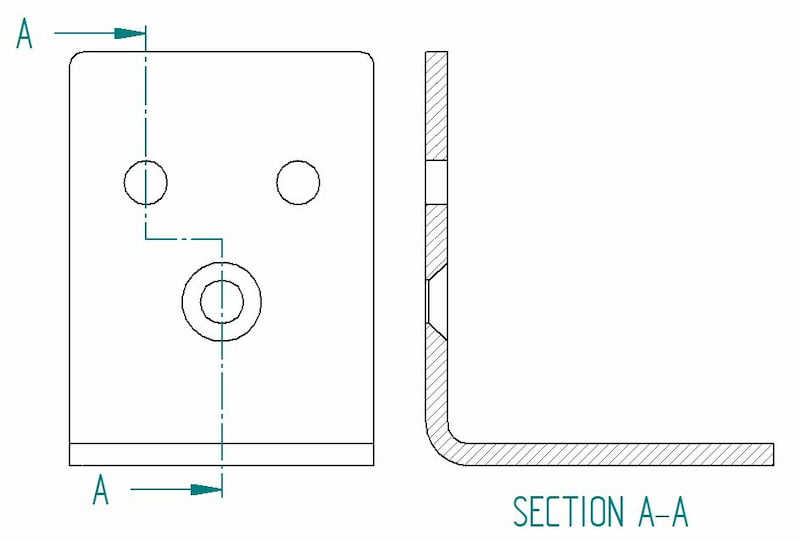
When using a cutout view, the cut plane lines bear witness the trajectory of the cutout. Hither you tin can run into that the A-A cutting line brings both types of holes into the view.
Types of Views
So allow'southward take a closer look at the unlike types of views that are often present in a manufacturing drawing. Each serves a certain purpose. Bear in mind that calculation views should follow the aforementioned logic as dimensioning – include as little every bit possible and every bit much equally necessary.
A tip for adept engineering science practise – only include a view if it contributes to the overall understanding of the design.
Isometric View
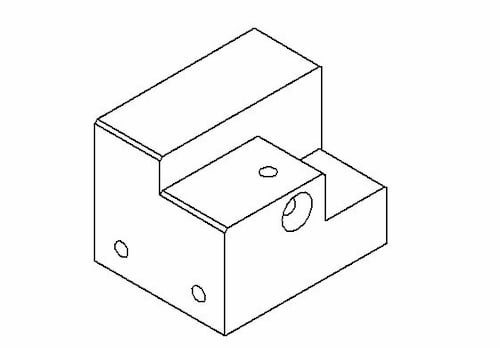
Isometric drawings show parts as three-dimensional. All the vertical lines stay vertical (compared to front view) and otherwise parallel lines are shown on a 30-degree angle.
The lines that are vertical and parallel are in their true length. Which means you can utilise a ruler and the scaling of the cartoon to easily measure the length straight from a paper drawing, for example. The same does not apply to angled lines.
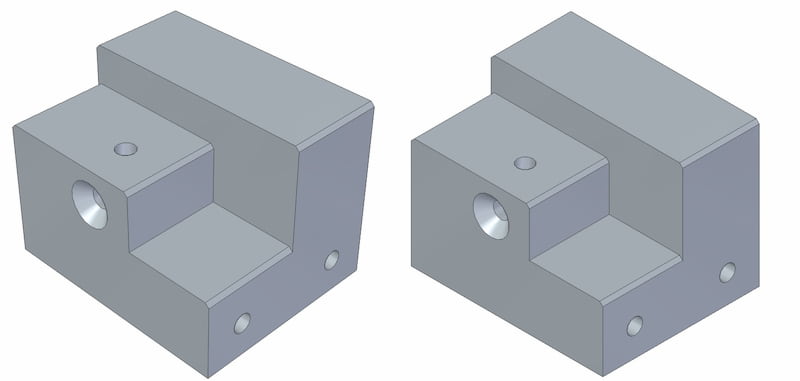
It is of import to distinguish the isometric view from a perspective view. A perspective view is an artistic ane that represents an object as it seems to the middle. Engineers stay true to the dimensions rather than optical illusions.
Orthographic View
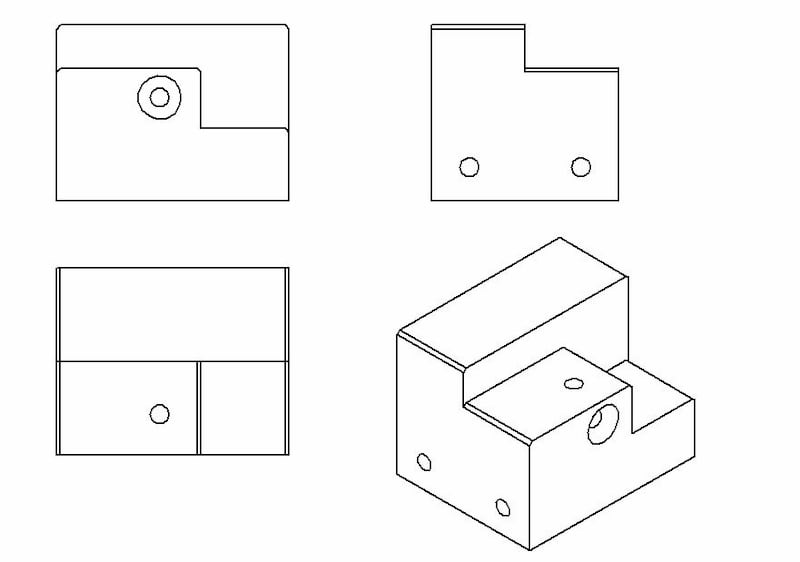
This is the bread and butter of an applied science drawing. An orthographic view or orthographic projection is a manner of representing a 3D object in two dimensions.
Thus, a 2nd view has to convey everything necessary for part production. This kind of representation allows avoiding whatsoever kind of distortion of lengths.
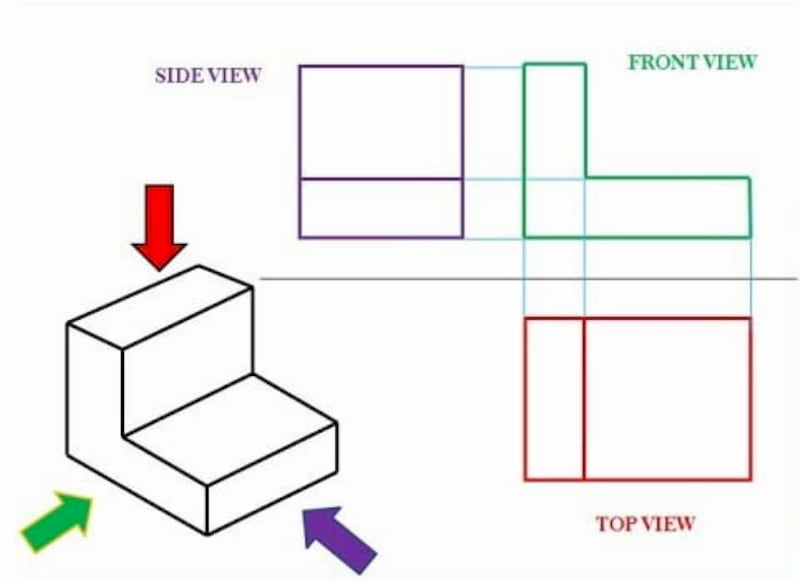
The virtually common way to communicate all the information is by using iii different views in a multiview drawing:
- Forepart view
- Top view
- Side view
It may be possible that some additional views are necessary to show all the info. But again, less is more than.
The positioning of the views differs a fleck regionally. For instance, look at the image below to compare the Us and ISO layouts.
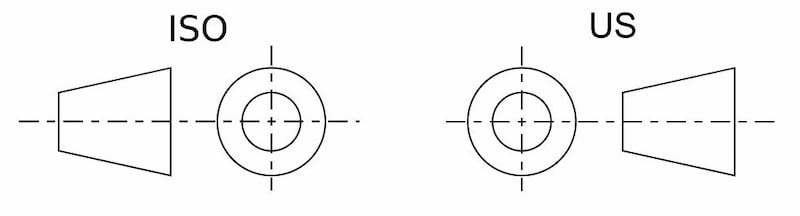
The ane on the left is called first-bending projection. Here, the height view is under the front view, the right view is at the left of the forepart view, etc. The ISO standard is primarily used in Europe.
On the right, you can see a third-angle projection. The correct view is on the right, top view on the top of the front view, etc. This system is particularly popular in the United states and Canada.
Flat Blueprint
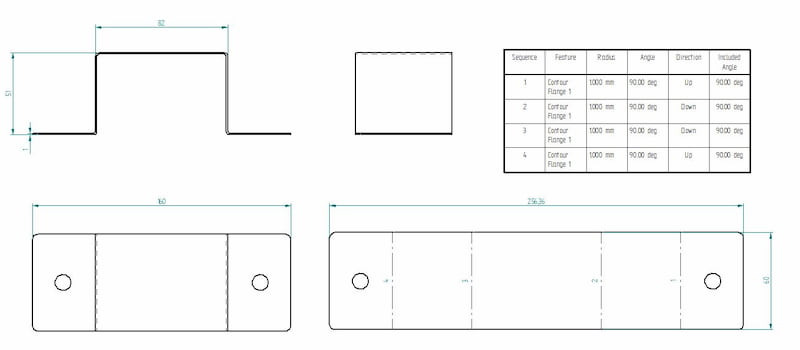
If you are making a folded sheet metal part, do not forget to add a apartment pattern view. The cut job comes before angle. When it comes to our customers, the easiest way is only to upload a STEP file without whatsoever accompanying drawings.
Creating a flat pattern view is usually pretty simple. Just exist aware that you are using the sheet metallic environment when making sheet metal parts in CAD. There you take the pick to "generate a flat pattern" which y'all tin can easily add to the main drawing.
If you lot are using the standard part surroundings, the same selection is not bachelor. Still, many CAD programs have the possibility to convert a standard part into canvas metal if the role properties correspond to sheet metal (e.m. uniform thickness, inside radius, etc.).
Section View
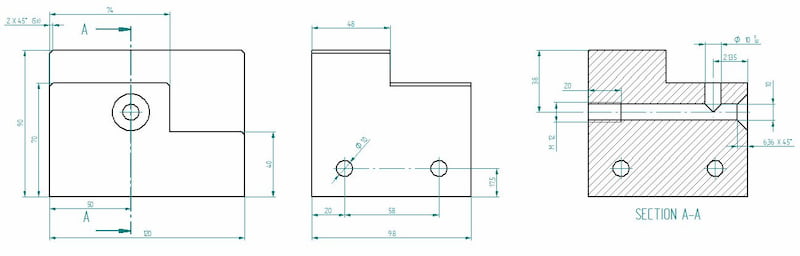
A section view can easily display some of the function features that are not evident when looking just from the get-go. Cross department is the preferred option compared to hidden lines as it brings more than clarity. The cantankerous hatching feature is and indicator for cantankerous sectional views.
Cutout View
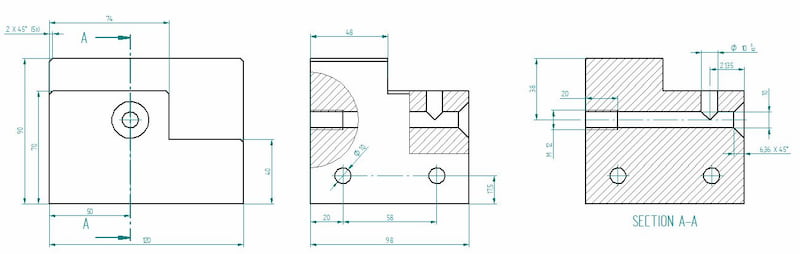
This is the aforementioned prototype we used for illustrating the section view. With one slight difference – the side view includes cutouts. Cutouts tin reduce the number of different views on a unmarried drawing.
Thus, we could hands delete the section view and add together all the necessary dimensions to cutouts.
Particular View
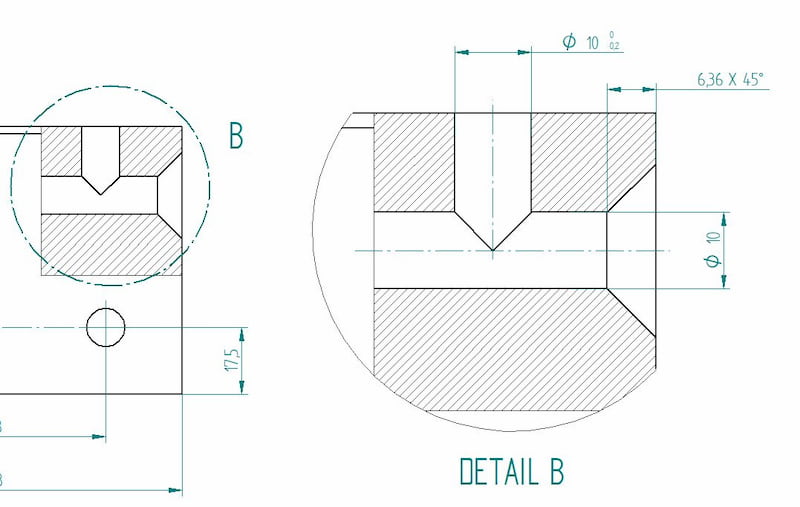
The particular view gives us a close-up of a selected department of a larger view. This can be peculiarly useful if an otherwise big office includes many important dimension in a modest area. Using the detail view improves the readability of these measurements.
Auxiliary View
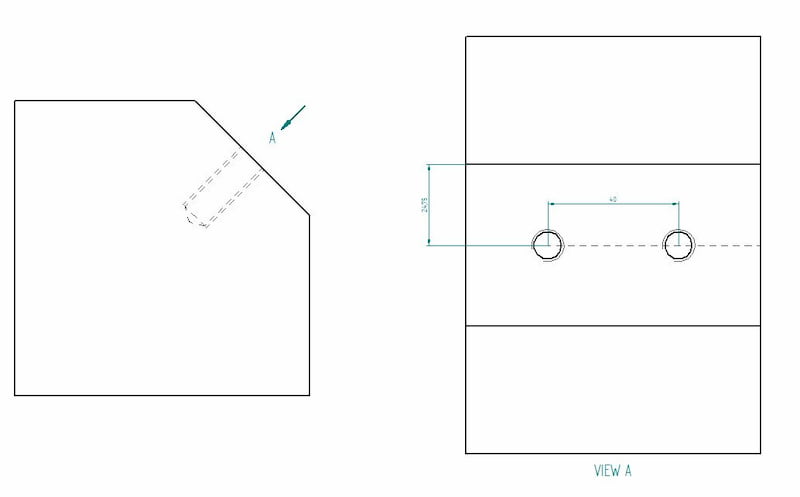
An orthographic view to correspond planes that are non horizontal or vertical. It helps to show inclined surfaces without any distortion.
Dimensions
As said earlier, new CNC machines are actually able to read the dimensions directly from the lines. But a traditional manufacturing drawing shows all the necessary dimensions for producing the parts.
The keyword here is necessary. Avert using the auto-dimensioning feature that a lot of CAD programs offering because they tend to prove everything they can find. For a beginner, it may seem similar adding it all ensures that no mistakes can be made.
Really, information technology can result in a confusing spider web of measurements that is left for the manufacturing engineer to untangle. Also, adding all dimensions you tin notice makes it hard to pinpoint which ones are the virtually important.
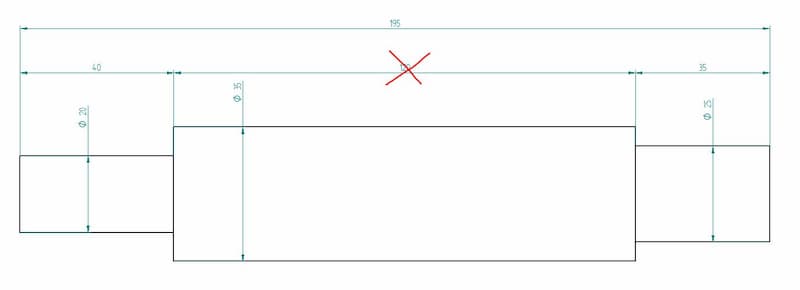
The image to a higher place shows a shaft with all the measurements. In reality, it creates a closed organisation whereby the manufacturer cannot guarantee all these dimensions 100%. Therefore, you have to make up one's mind the most important ones. In our example, we chose the terminate steps to be more important than the length of the central part. Thus, we should delete the 120 mm dimension.
One crucial bit of data that is missing from CAD models is geometric dimensioning and tolerancing (GD & T). For example, when looking to produce a shaft for a begetting system, limits and fits are of high importance. The correct dimensions can guarantee a longer lifetime with less maintenance.
While you can fetch all the dimensions automatically by clicking the measure out push, calculation engineering tolerances needs manual activeness.
Therefore, adding dimensions with lower and upper limits or fit classes is yet important. Regarding Fractory'south service, nosotros would ask you to enclose a carve up cartoon with these parameters. Note that y'all practice not accept to provide the whole dimensioning – only include the tolerances of a unmarried hole on your engineering science drawings if necessary.
Information Blocks
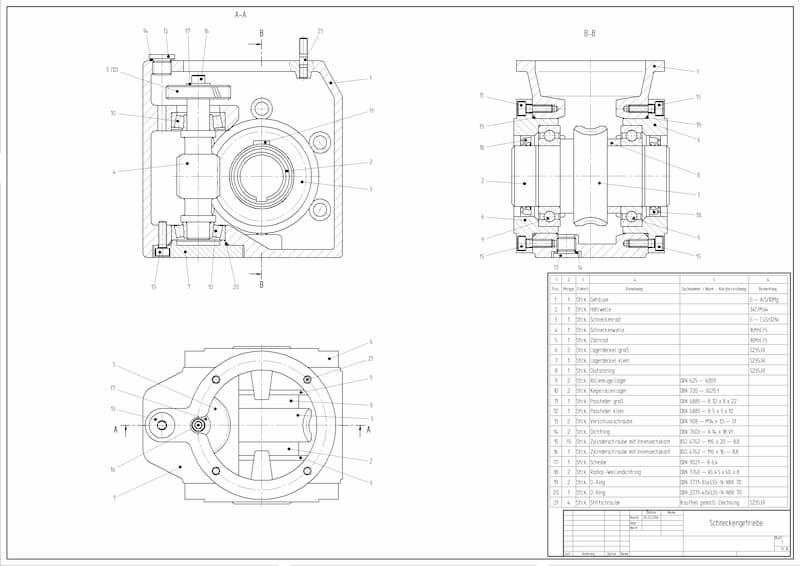
The little boxes in the bottom right corner show additional information. The title block includes the writer'due south name, part name, part number, quantity, coating, scale, etc. There can exist much more info on in that location but the championship blocks vary widely betwixt different companies.
Information blocks also include a beak of materials, or BOM for short. These blocks listing all the components used in the associates, forth with additional information similar quantities, function names, etc.
Associates Drawings
Many engineers' drawings make the mistake of trying to include all the information about each individual office in an associates cartoon. To avoid this, remember the purpose of these engineering drawings during the cosmos process – they must make the assembling easy.
Exploded views, section views, numbered parts, general dimensions, cutouts, detail views (or close-ups) are all tools you tin use to achieve this goal.
It should exist clear where each office goes and how it is attached – whether it needs welding, bolted connections, riveting or something else. The bill of materials is at that place to assist you, so brand certain the information available there is right regarding part numbers, names and quantities.
Keeping everything above in mind volition help you create associates drawings that make life easier on the store floor. A piece of cracking advice I once received goes like this – proceed the thinking in the cartoon-room. Avoiding multiple interpretation possibilities at later steps will significantly decrease the number of errors.
What Does the Hereafter Hold?
Engineering science drawings are however a large part of an engineer's chore. All in all, making them contributes to near 20% of a pattern engineer's work time.
We at Fractory are trying to salve this time by automating the reading of 3D models for production. This leaves engineers with the task of producing associates and GD&T drawings only. The purpose is to keep the focus on engineering better products.
The applied science community is seeing this movement equally a new tendency. But as we all know, taking the whole industry up to a new standard takes a lot of time. Thus, if you nevertheless outsource your production to manufacturing companies who need drawings, you lot must know the basics at the very least.
Leaving room for interpretation creates a situation where your idea may non be executed every bit planned. And there is nobody else to blame just the author.
And then consider this stage of the product evolution process every bit an integral part that requires thinking along. Proceed the thinking in the cartoon-room.
Source: https://fractory.com/engineering-drawing-basics/
0 Response to "Vertical Plane in Engineering Drawing"
Postar um comentário